Show Mobile Navigation

Thursday, 28 July 2011

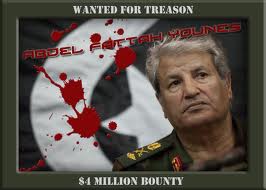
The head of the Libyan rebel's armed forces and two of his aides have been killed by gunmen,

El NACHO - 23:22

The head of the Libyan rebel's armed forces and two of his aides have been killed by gunmen, the head of the rebel leadership has said.

The death of Abdel Fatah Younis was announced at a press conference in the rebel capital, Benghazi, by the head of the rebels' National Transitional Council, Mustafa Abdul Jalil. He told reporters that rebel security had arrested the head of the group behind the killing.

Rebel security had earlier summoned Younis for questioning about suspicions his family still had ties to Muammar Gaddafi's regime.

Younis was Gaddafi's interior minister before defecting to the rebels early in the uprising.

Abdul Jalil said Younis had been summoned for questioning regarding "a military matter". He said Younis and his two aides were shot before they arrived for questioning.

Abdul Jalil called Younis "one of the heroes of the 17th of February revolution", a name marking the date of early protests against Gaddafi's regime.

While he criticised Gaddafi for seeking to break the unity of rebel forces, he did not say directly that Younis's killers were associated with the regime. Instead, he issued a stiff warning about "armed groups" in rebel-held cities, saying they needed to join the fight against Gaddafi or risk being arrested by security forces.

Wednesday, 27 July 2011

UK expels Gaddafi diplomats and recognises Libya rebels

El NACHO - 12:57

William Hague has said the UK will recognise the Libyan rebel council as the "sole governmental authority", as Gaddafi-regime diplomats are expelled.

The Libyan charge d'affaires was called to the Foreign Office earlier to be told he and other diplomats must leave.

Instead the UK will ask the National Transitional Council to appoint a new diplomatic envoy.

It follows similar moves by the US and France. The UK previously said it recognised "countries not governments".

A Foreign Office spokesman said that had not changed and said it was a political, not legal recognition.

The green flag of the Gaddafi regime was still flying outside the embassy in Knightsbridge on Wednesday afternoon and attempts to reach embassy staff for comment were not successful. Protesters carrying the red, green and black flag of the Libyan rebels gathered outside.

Libyan rebels and pro-Gaddafi forces are still locked in battle, five months after an uprising began against Muammar Gaddafi's 42-year rule, as Nato continues to enforce a UN-backed no-fly zone over the country.


Friday, 22 July 2011

Libyan representatives are ready to hold more talks with senior U.S. officials, a Libyan government spokesman said on Friday.

El NACHO - 22:36


Libyan leader Muammar Gaddafi is also encouraging his people to talk to rebels but he will not speak to the insurgents himself, the spokesman said.

Libyan oficials have held six meetings with senior rebel representatives, he added.

The spokesman said Libya was willing to meet U.S. government officials again, following a meeting in Tunisia last weekend at which Washington said it had delivered a clear message that Gaddafi must step down.

"There was a meeting in Tunisia between senior U.S. and Libyan officials. There was what we believe is productive dialogue," he said.

"We did explain many things to American officials. We realized they did not have the full picture; we corrected much misinformation.

"We believe other meetings in the future ... will help solve Libyan problems ... We are willing to talk to the Americans more," the spokesman said.

The spokesman said Libya, after five months of war and a NATO bombing campaign, remained "very powerful we are not falling; we are not falling apart."

Libyan leader Muammar Gaddafi has ruled out talks with the rebels seeking to end his 41-year-rule.

El NACHO - 22:13


"There will be no talks between me and them until Judgment Day," Gaddafi told a crowd of thousands of his supporters in his home city of Sirte on Thursday in a remotely delivered audio message. "They need to talk with the Libyan people ... and they will respond to them."

Gaddafi's remarks come as Libya's foreign minister reportedly met with his Russian counterpart to discuss Gaddafi's exit from the country.

The audio message, however, cast doubts on a flurry of recent international efforts to negotiate an end to a deepening conflict.

In another speech broadcast by Libyan television, Gaddafi addressed "a meeting of Misurata tribes", calling for "a march on the city (east of Tripoli) to liberate it" from rebels.

Meanwhile, the rebels have escalated their offensive against Gaddafi's forces east of the capital Tripoli, capturing one of the most prominent government commanders along the way.

After two days of fighting, they moved their position to about 4km forward from Dafniyah, a small town between Zliten and Misurata.

"We move forward [now] towards Zliten," said Ayman, an opposition field commander, referring to the coastal town 160km east of Tripoli.


"We are now close to an area called Tuesday Market in Zliten and, God willing, we will liberate our people in Zliten soon from the forces of the tyrant."

The Libyan government said that NATO air strikes targeted civilian sites in Zliten. Foreign media were shown destroyed buildings and wounded civilians in the town.

Al Jazeera's Hoda Abdel Hamid, reporting from Misurata, described General Abdul Nabi Zayed, the captured commander, as one of the most high-value prisoners taken by the opposition to date.

Zayed allegedly co-ordinated the deployment of tanks into Misurata in March which triggered the recent fighting.

"According to the military commanders here in Misurata, Zayed was actually captured yesterday as they started their offensive towards the town of Zliten. He was slightly injured, so he was brought back to the hospital here in Misurata," she said.

"Its also a significant catch because it is happening at the time the opposition started their push towards Zliten. They have made significant territorial gains. Rebel commanders are saying they are interrogating General Zayed and they are hoping he will give them significant information."

Boobytrapped oilfields

In another claim on Thursday, opposition officials said Gaddafi forces had boobytrapped vital petroleum installations in Brega so they could be blown up if his forces lost the oil town.


Qatari munition-labelled boxes sent to Libya

Mahmoud Jibril, the opposition diplomatic chief, characterised Brega on Thursday as a "big minefield" and said some oil installations were "full of bombs, explosives".

The advance towards Brega has been slowed by vast quantities of anti-personnel mines planted by retreating Gaddafi loyalists and the difficulties in attacking an estimated 200 government troops fighting from positions near the oil facilities.

At least 72 opposition fighters have died and 623 others injured since the push was launched on July 14 for Brega, located 800km east of Tripoli and 240km southwest of Benghazi, the opposition stronghold.

On the war's western front, opposition commanders said they were awaiting orders from Benghazi to start a fresh offensive from the Nafusa Mountains, just days before the Muslim fasting month of Ramadan.

Energy shortage

With no end to the conflict in sight, the Libyan opposition is seeking new supply deals to import fuels into eastern parts of the country to help alleviate energy shortages, a source in the opposition oil ministry said on Thursday.

Even in peacetime the oil producer still needed to import some fuels because of insufficient refining capacity. Increased military demand and damage to oil infrastructure have further boosted import requirements.

"Vitol are providing some fuels but I'm not sure it's enough to serve the whole country. They are pursuing other suppliers," a source in the opposition oil ministry said.

Vitol, a trading firm, has been the opposition's major oil trading partner since the war began and has regularly shipped cargoes of oil products including diesel - badly needed to keep the country running.

Al Jazeera's Anita McNaught, reporting from the eastern town of Jalu, said the Gaddafi forces have repeatedly crossed the eastern desert south of Benghazi to destroy oilfield infrustructure.

"In early July, they attacked a pumping station in Field 103, southwest of Jalu, and boobytrapped the engine room with landmines," she said.

"War has brought oil production in Libya to a standstill. And Gaddafi is determined to prevent the opposition in the east from starting its own oil business."

A former Canadian general was on Thursday demoted and fined for having a sexual affair with his subordinate while he was posted in Afghanistan.

El NACHO - 21:05


Former brigadier general Daniel Menard, who pleaded guilty to having a sexual relationship with his subordinate before a court martial, was fined $7,000 and demoted to the rank of a colonel.

Menard, who commanded Canadian forces in Afghanistan, had met Corporal Bianka Langlois in Canada in 2008. The two continued their affair when the general was given command of Canadian forces in Afghanistan and she was also posted there.

Though Canadian Forces rules prohibit inappropriate relationship among military personnel, the general "had numerous trysts in her living quarters. Menard also kissed Langlois in his office on more than one occasion."

An inappropriate relationship as per Canadian Forces rules could be "an emotional, romantic, sexual or family relationship, including marriage or a common-law partnership or civil union, between two CF members, or a CF member and a DND (department of national defence) employee or contractor, or a member of an allied force."

Menard was relieved of his duties in Kandahar and ordered home for engaging in "sex in theatre" with the female trooper.

Langlois was given an official reprimand and fined $700 in September for sleeping with her boss.

The 45-year-old former general, who quit the military last year, said, "It was clear I was no longer in the club of generals. I felt completely ostracised. I concluded I didn't have a place anymore."

Once considered a rising star of the Canadian military, Menard is now looking for a job.

Canada’s diplomatic corps in Kabul did not go thirsty.

El NACHO - 21:04


Hospitality forms show embassy staff and dignitaries drank plenty of booze while posted to Afghanistan, an Islamic country where imbibing is not just taboo, it’s against the law.

The embassy consumed close to 3,000 bottles of alcoholic beverages from mid-2007 to last November. The tab for the beer, wine and hard liquor was at least $20,000.

Two British passport holders seized by special forces in Herat and taken to secure facility in Kandahar for questioning

El NACHO - 21:03

British couple seized by special forces in Afghanistan in an unprecedented operation are suspected of planning a terrorist attack in the UK, the Guardian understands.

The man and the woman were seized by British special forces in the western Afghan city of Herat and transferred to a "secure facility" in Kandahar, the Ministry of Defence said last night. The operation is highly sensitive and potentially a legal minefield, officials made clear.

There have been unconfirmed reports in the past about British-born individuals, some heard speaking with strong British accents, joining the Taliban-led insurgency in southern Afghanistan. However, this is believed to be the first time any terrorist suspects have been captured in Afghanistan, officials said.

The two are believed to be known to British security services and may have travelled to Afghanistan for training purposes or to contact militant groups there. Whatever their purpose in going to Afghanistan, British officials made plain that the capture of the couple was a "counter-terrorist" operation. Britain's special forces, of which there are about 500 in Afghanistan, work closely with the security and intelligence services there.

The couple were seized at a hotel in Herat, a prosperous commercial centre with close links to Iran, in a joint operation with the Afghan intelligence service, the National Directorate of Security (NDS), according to defence officials. Officials described the operation as "terrorism-related" and "UK-led". The role of the NDS remained unclear last night.

The MoD: "We can confirm that two British passport holders were detained in an Isaf [International Security Assistance Force] operation conducted jointly last week by UK forces with Afghans in support … Detention operations are a vital element of protecting UK, Isaf and Afghan forces and Afghan civilians from those who are assessed to pose a threat regardless of their nationality." As if to underline the legal sensitivities surrounding the operation, the MoD continued: "All detention operations in Afghanistan carried out under the remit of the UN mandated [ISAF] which includes those conducted by British forces, are conducted in accordance with international law and strict policy frameworks".

Nato forces can hold suspects for up to four days before releasing them or handing them over to the Afghan authorities. However, the period can be extended. The Foreign Office said: "The UK has a national policy of detaining beyond 96 hours in exceptional circumstances, in particular where it could provide information that could help protect our forces or the local population."

The Afghan authorities may insist the couple should remain in jail in the country pending a trial. The British authorities will have to decide whether there is sufficient evidence to extradite them to the UK.

Clive Stafford Smith, director of the legal charity Reprieve, which campaigns for prisoners' rights, has written to the Foreign Office to ask for clarification of the Britons' legal positions. He said: "We are extremely concerned – if they were to be transferred to Afghan custody, they would not only face the death penalty, but also would face serious torture as well."

The arrests came as the UK handed responsibility for security in Helmand's capital, Lashkar Gah, to Afghan forces on Wednesday in a step towards the planned pullout of British combat troops by the end of 2014. Nato troops have also handed over control of security in Herat, the fourth of seven areas to handover to Afghan control this week. However, the capture of the two Britons, and concerns about their possible intentions are not linked to the transfer of security to Afghan forces, officials said.


Eleven killed during mass protests in Syria

El NACHO - 21:00

Syrian forces shot dead at least 11 people during mass protests on Friday against President Bashar al-Assad, rights activists and witnesses said.

Five civilians were killed overnight in Homs, 165 km (100 miles) north of the capital Damascus, when tanks were deployed to halt protests in the besieged city, residents said.

A further six were later shot dead in protests in the Damascus suburb of Mleeha, in Homs, and in the Idlib area in the northwest, the Syrian Observatory for Human Rights and the National Organisation for Human Rights said.

"So far we have six martyrs across the country. All six were killed today," said Ammar Qurabi, head of the National Organisation for Human Rights.

The four-month-old uprising is the biggest challenge to Assad's authority since he succeeded his father 11 years ago and it is spreading.

Rights activists reported protests after Friday prayers in several places -- the Medan district of Damascus, Latakia on the coast, Deraa in the south and Deir al-Zor in the east -- as well as Homs, the latest focus of the armed crackdown on protesters.

"Tanks and armoured vehicles have deployed in Homs thoroughfares, but in every street adjacent to them there are people in the streets," a resident of Homs, who gave his name as Osama, said by telephone.

Once confined to outlying towns and rural regions, the uprising has now taken a firm hold in cities such as Homs and Hama, scene of a 1982 massacre by the military.


Tuesday, 19 July 2011

Libyan troops kill 8 rebels near eastern oil town

El NACHO - 19:12

Government forces in trucks disguised with rebel flags shelled opposition positions Tuesday near the strategic eastern oil town of Brega, killing eight rebel fighters and wounding dozens more, officials said.
Rebel forces have been pushing to seize the front-line town on Libya's coast for nearly a week, but they say fields of land mines planted by Moammar Gadhafi's forces have slowed the advance.
The rebels are fighting in a residential area on the town's eastern side and control about one-third of the town, spokesman Mohammed al-Rajali said.
Field commander Ahmed Maysawi said rebel forces were working to clear the mines so they can move forward while government troops are occasionally approaching in trucks disguised with rebel flags to shell rebel positions with mounted rocket launchers.
A NATO spokesman said he could not confirm rebel claims about Brega, saying only that the situation there remained "very fluid."
"It would be premature for us to come with a verdict with respect to the situation there, so this will be something we need to monitor closely in coming days," said Col. Roland Lavoie, spokesman for the alliance's operational headquarters in Naples, Italy.
Mohammed Idris, a doctor at the hospital in the nearby city of Ajdabiya, said eight rebels were killed and dozens wounded Tuesday. That raised to at least 34 rebels killed in five days of fighting, according to Idris.
He said the rebels had taken four prisoners, and one dead government soldier had been taken to the rebel hospital. It is unclear how many other government soldier have been killed. The Libyan government rarely provides information on its casualties.
Rebels struggling to oust Gadhafi since the uprising against his rule broke out in February control much of Libya's east, but Brega, 450 miles (750 kilometers) southeast of Tripoli, has been under government control since early April.
The two sides have been locked in a stalemate with the rebels unable to advance beyond pockets in the west despite a NATO air campaign against Gadhafi's troops.
Last week, more than 30 nations including the United States gave the rebels a boost by recognizing their National Transitional Council as the country's legitimate government, potentially freeing up billions of dollars in urgently needed cash.
The International Committee of the Red Cross said Tuesday that medical services in Libya's western mountains are struggling with a flood of casualties from fighting.
Tuesday's statement said facilities lack medicine to treat patients and vaccines to deal with outbreaks of disease.
An ICRC delegation visited the region and provided bandages and other medical materials.
Arab and Berber rebels wrested control of much of the Nafusa mountains from the government weeks ago. The range stretches from the Tunisian border to within 60 miles (100 kilometers) of Tripoli.
But rebels have been unable to capture the strategic mountain town of Gharyan, which controls the approach to the capital.


Thursday, 14 July 2011

Greek taxi driver arrested over the murder of a British teenager who was on his first foreign holiday told people at the scene that he was 'annoyed' that a laser had been shone in his eyes.

El NACHO - 11:05

The Greek taxi driver arrested over the murder of a British teenager who was on his first foreign holiday told people at the scene that he was 'annoyed' that a laser had been shone in his eyes.

It is alleged that one of the drivers was heard saying: 'I was annoyed because the young British tourists bothered us with lasers'

Robert Sebbage, who was once an England football mascot, collapsed and died in the street after a blade was plunged into his heart during a confrontation with two taxi drivers in the early hours of yesterday morning.

The 18-year-old's close friend, Jordan Manson, was taken to hospital with deep cuts to his chest and a collapsed lung following the attack in the resort of Laganas on Zakynthos.


Stabbed: Robert Sebbage's dream came true when he was given the chance to be an England mascot

Three others in their group also needed medical treatment.

Police officer Dimitris Angeloudis said that the row started because of a row over cab fares.

'Tempers flared, they exchanged insults, then began beating each other,' he told The Sun. 'Then the cabbie just lost it.

'There are no words to explain why he went so berserk, but he suddenly produced a knife and, egged on by a friend, lunged out and stabbed whoever he could.'

The youngsters, who were on their first foreign trip together, were all unarmed and running away when they were attacked, according to reports.


Last picture? Robert in Zakynthos

Hours before the attack, Robert, had contacted his parents in Basingstoke, Hampshire, to say he was having a great time.

Andrew and Rhian Sebbage broke down in tears yesterday on being told of his death. A postman delivered their son's Reading FC season ticket moments later.

'He was out there with friends and they were due to fly back tomorrow,' said Mrs Sebbage, a 46-year-old primary school learning support assistant.


'I had spoken to him while he was away and he was having a fantastic time.'

Robert, who had two older brothers Martin, 23, and Steve, 19, suffered from neuropathic bowel disorder, a rare medical condition which affects only a handful of Britons.

Despite needing regular hospital treatment as a child, he had managed to complete his penultimate year in college and was in Greece to celebrate the achievement.

He became an England mascot in 2007, a treat arranged by the Rays of Sunshine charity, which grants wishes for seriously and terminally-ill children.

Aged 14, he walked out on to the Wembley pitch with England goalkeeper Paul Robinson and met David Beckham before the national team took on Brazil.


Although Zakynthos is popular with British tourists, the Ionian island has been plagued by incidents of violent and rowdy behaviour by holidaymakers.

Witnesses said the fight broke out at 3am following a dispute over fares. Stelios Morfis, 21, is alleged to have grabbed the knife from his vehicle and launched himself at the Britons, fatally injuring Robert.

Another Greek, Dimosthenes Mylonas, 25, allegedly wielded a wooden baton.

Both have been arrested. Morfis, formerly a bodyguard for the island's mayor, has been charged with premeditated murder. Mylonas has been charged as an accomplice.

Dimitris Angeloudis, who is leading the police investigation, said: 'A holidaymaker lost his life over a misunderstanding, over insults and macho behaviour by young men on either side.

'There is no evidence whatsoever that the British youths were armed with knives or any similar dangerous instrument.


The family home where Robert lived with his parents Andrew and Rhian


Weapon: The jack-knife that claimed Robert Sebbage's life, pictured above, was thrown into the sea

'Witnesses testified that there was a full-fledged brawl. Then at one point the accused drew a knife and stabbed the victim several times in the side of the ribs, at the level of the heart.

'He has confessed to his actions and has been charged with premeditated murder.'

Police said the knife used in the attack was recovered after being thrown into the sea.


'I feel, angry, frustrated and depressed that I can no longer take part in the one thing I love. However, I will never give up on supporting England. It would be a real dream come true for me just to wear the England kit and walk out of that tunnel as a mascot for my team.

'Just hearing the roar of the cheering crowd, meeting the players and drinking in the atmosphere would be the greatest honour for me. It would more than make up for the fact that I can no longer play. It would give me a spectacular day to remember and nothing could take that memory from me.'

Jordan's father Nigel said none of the youngsters had ever been in trouble: 'They are all such lovely boys and when the police visited us, they could not find anything on their systems because not a single one of them has a black mark against his name.'

The 59-year-old garage boss from Tadley in Hampshire added: 'They have been pals for years and went to the same schools and colleges and this was their first foreign holiday as a group.'

He said his son had been attacked and left for dead. The 18-year-old, who is set to start an apprenticeship as a mechanic later this summer, is now stable after being operated on yesterday morning.

Samuel Champion, Steven Granston and Callum Lane, all aged 18, were also injured. They were in a group of seven on a week-long holiday with Thomas Cook. The tour company is helping the victims' families travel to Greece.

The two remaining members of the party escaped the altercation entirely.

Friends have created a tribute page on Facebook to the teenager who listed his interests on his own page as being a keen fan of Reading FC and the bands Oasis, Kasabian and Kings of Leon.

One friend, Chloe Prince, wrote: 'one of the most genuine lads I have ever met! such a lovely boy, you'll never be forgotten! r.i.p.'

Kayley Tompkins wrote: 'Rip rob. Make sure you keep that gorgeous smile of yours blooming up there! Never forgotten always missed.'

Kelly Louise added: 'One In A Million. Gonna Miss That Cheeky Little Face Of Yours. Sleep Tight You Beaut! All My Love.'

Monday, 11 July 2011

eleven people have been killed after a series of explosions at a munitions dump in southern Cyprus.

El NACHO - 08:01


Several huge explosions hit the Zygi naval base early on Monday morning.

"There were 98 containers of gunpowder. Two of them [caught] fire and huge explosions occurred," the Cyprus News Agency quoted a police spokesman as saying.

Kostas Yennaris, a journalist for Greek national television who is based in Nicosia, the capital, told Al Jazeera that there was a "huge explosion" and that ambulances and fire trucks were seen rushing to the scene.

He said that the site of the blasts had been cordoned off by the authorities, but debris from the explosions had been spread "over a huge area". Local media reported that the explosions sparked wildfires in adjacent scrubland.

Aliki Stylinaou, a defence ministry spokeswoman, said that the death toll could not immediately be confirmed, but local media quoted sources as saying that it was at least eight, with as many as 30 feared injured.

'Biblical disaster'

"It looks like a bombed-out landscape," a witness told Sigma television.

A spokesman for the state-run electricity authority said that the blasts, which struck shortly before 6:00am local time (3:00am GMT), also damaged the island's largest power station.

"We can't assess the extent of the damage, but it's a biblical disaster," spokesman Costas Gavrielides told Reuters.

Yiannis Tsouloftas, an official with the utility, said that the station had sustained extensive damage as a result of the concussion wave of the blast. He said that it would remain offline for at least Monday, with the island's two smaller power stations attempting to cover electricity demand.

The Vassilikos power station is very close to the Evangelos Florakis navy base, where the explosions occured. The base is located between the coastal cities of Limassol and Larnaca on the south side of Cyprus.

Saturday, 2 July 2011

Dozens of Syrians have been arrested in a security force crackdown on anti-government protesters, activists

El NACHO - 21:11

Dozens of Syrians have been arrested in a security force crackdown on anti-government protesters, activists said Saturday, after tens of thousands of people rejected President Bashar al-Assad's latest promise of reform, dpa reported.

At least 41 people have been detained in Tasil town, in the southern city of Daraa, where security forces stormed houses and shops, activists said.

More arrests have been carried out in the northern province of Idlib and in the central city of Aleppo, the Local Coordination Committees of Syria said.

Also Saturday, Al-Assad sacked the governor of the western province of Hama, where thousands of anti-government demonstrators had packed the provincial capital the day before.

The president had "issued a decree discharging Ahmed Khaled from his position as the governor of Hama," Syrian state television reported.

Army forces launched a crackdown on protesters in Hama early last month.

This is the third time al-Assad has sacked a governor since anti-government protests began in mid-March. He has already replaced the governors of the southern Daraa province and the western Homs.

Hama was the scene of a lethal government crackdown in 1982 that killed up to 20,000 people. Sunni residents of the town had attempted to revolt against then president Hafez al-Assad's minority Alawite sect.

According to the Syrian Observatory rights group, 1,365 people and 340 security personnel have been killed since the latest protests began. A further 10,000 have been detained, according to rights advocates.

Human Rights Watch said government forces should immediately halt the excessive use of force and free everyone detained for exercising their rights to free expression.

The group said that security forces and their loyalists have killed at least 21 people in the third-largest Syrian city, Homs, since June 17.

The statement, which quoted witnesses and other human rights groups, said that "during the protests security forces have beaten protesters with clubs, vandalized private property, and broken into homes where they suspected protesters had sought refuge."

"President Bashar al-Assad's promises of new laws allowing more political participation ring hollow when security forces are still above the most basic laws," said Sarah Leah Whitson, Middle East director at Human Rights Watch.

Last month, al-Assad said a national dialogue would start soon to review new legislation including laws on parliamentary elections as early as August, draft a new media law, and allow political parties other than the ruling Baath Party, as well as look at possible changes to the constitution.

Tens of thousands protested across Syria on Friday, rejecting al-Assad's promises or reform and calling on him to leave power.

Around 15 people were killed when security forces used live ammunition and tear gas against protesters, according to activists.

Tuesday, 28 June 2011

Afghan central bank chief quits, flees to US

El NACHO - 02:27

The governor of Afghanistan's central bank, Abdul Qadeer Fitrat, says he is resigning because he thinks his life is in danger.

Speaking in the United States, he says he is in danger because of a corruption scandal which brought down the privately owned Kabul Bank.

The Kabul bank allegedly was engaged in years of fraud involving well-connected shareholders, including the brother of Afghan president Hamid Karzai.

Mr Fitrat says he has been prevented from holding a proper investigation into the embezzlement of around $500,000.

And he says the situation got worse when he exposed the alleged corruption in parliament.

"My life was in danger and also there were other conspiracies that I thought probably could happen," he said.

"That's why after I received that credible information I tried to leave Afghanistan and announce my resignation here, in Washington."

The US State Department has confirmed Mr Fitrat is in Washington.

"We do know that he is in Washington," spokeswoman Victoria Nuland said.

"If there were to be a change of leadership at the Afghan Central Bank, we would continue to encourage that government to take all the necessary steps to reform and strengthen the financial sector."

Ms Nuland said she had no information about whether Mr Fitrat had asked for asylum.


Monday, 27 June 2011

Rebels have been engaged in fierce firefights with government forces in mountain plains about 80km (50 miles) south-west of Tripoli.

El NACHO - 01:11


A BBC correspondent who was with the rebels was told by a volunteer medic two of them had died in the battle.

The rebels said government forces suffered far greater casualties, although that cannot be confirmed.

Meanwhile, Col Muammar Gaddafi has agreed to stay out of talks on ending the conflict, African leaders said.

In a communique after talks on Sunday in South Africa, the African Union panel on Libya said it "welcomes Colonel Gaddafi's acceptance of not being part of the negotiations process". The statement did not elaborate.

Sunday, 26 June 2011

A young maid is facing death by beheading in Saudi Arabia for a crime she claims she did not commit.

El NACHO - 14:26


Rizana Nafeek, who alleges she was a teenager at the time of the incident, was arrested in May 2005 on charges of murdering a four-month-old baby who was in her care.

She denies murder and claims she desperately tried to save the child who choked while she was looking after it.

Saudi Arabia have come under fire from Human Rights groups for the handling of her case after it was revealed there had been a mix-up involving the year she was born in.

The authorities have her date of birth as 1982 however her birth certificate states she was born in 1988 - making her 17 at the time of the alleged incident.

If Saudi Arabia went ahead with the execution it would be in breach of the United Nations Convention on the Rights of the Child, which it has ratified.

Human Rights groups claim Rizana had no legal representation before or during her trial.

Sri-Lankan born Nafeek's mother Rafeena said her daughter moved to the country so that she could send money home to help educate her three siblings.


Desperate: Her mother Rafeena, left, has begged King Abdullah, right, to pardon Rizana

Desperate for work she found a job as a domestic worker but was shocked when she was asked to look after a baby, Naif al-Quthaibi, because she believed she did not have the skills to care for him.

Just weeks into her employment tragedy struck and the infant choked while he was being fed.

Rafeena, who lives in a tiny village, has previously begged King Abdullah to pardon her daughter and asked him to allow her to return home.

If the execution goes ahead the now 23-year-old will dressed in a white robe and be marched into a packed town centre.

She will also be blindfolded, shackled and forced to kneel facing Mecca before she is prodded between the shoulders so her head is raised


Outrage: Ruyati binti Sapub, an Indonesian, was killed for murdering her employer after she claims she was repeatedly abused

naturally.

Rizana will then be executed, medieval style, with one sweep of a sharply-bladed sword.

Amnesty International has condemned the conviction and since revealed Rizana was not allowed to produce her birth certificate which shows her true age during an appeal trial.

The charity's Middle East director Malcolm Smart said at the time: 'It would be outrageous if Rizana Nafeek were to be executed for this crime.

'It appears that she was herself a child at the time and there are real concerns about the fairness of her trial.'

According to the Sunday Express, earlier this month Indonesia banned its citizens from working in the oil-rich country after another maid, Ruyati binti Sapub, 54, was beheaded after she confessed to killing her employer with a meat cleaver because of constant abuse.

The incident caused outrage and Saudi diplomats in Indonesia were forced to apologise for not informing them about the execution beforehand.

The bodies of soldiers killed in Afghanistan will no longer be honoured with a public parade but will be driven through back streets to avoid upset, it has emerged.

El NACHO - 14:24

For several years, the flag-draped coffins of fallen servicemen and women have been met by large crowds who line the streets to pay their respects as they return to British soil.
But repatriation flights are to be diverted and will no longer be flown back to RAF Lyneham and through the small Wiltshire town of Royal Wootton Bassett, where they were saluted come rain or shine.
Instead, they will arrive back to RAF Brize Norton, where they will be driven through the back gate and then down side roads, neatly avoiding the nearby town of Carterton, as they make their way to the John Radcliffe Hospital in Oxford.
Andrew Robathan, Minister for Defence Personnel, Welfare and Veterans, admitted that the decision to avoid public scenes of emotion had been taken deliberately.
“The side gate was seen by the Ministry of Defence and the police as the most appropriate way to take out future corteges,” he told Radio Oxford.


Thursday, 23 June 2011

U.S. President Barack Obama announced Thursday to begin pulling out U.S. troops from Afghanistan in next July

El NACHO - 08:16

While U.S. President Barack Obama announced Thursday to begin pulling out U.S. troops from Afghanistan in next July, the war-weary Afghans have shown mixed reaction towards the decision.

"The decision will not change the course of the war and will not convince the Taliban to give up fighting. In the presence of the U.S. and allied forces, we have suffered, and would continue to suffer in their absence," taxi driver Mohammad Musa in Kabul, the capital of Afghanistan, told Xinhua on Thursday morning.

He also doubted U.S. war on Taliban and troops drawing down, saying "The United States can withdraw a few hundred soldiers this morning and it can bring a few thousand tomorrow night if it likes to do so."

A student of Kabul University Mohammad Khan said that "the U.S. forces withdrawal from Afghanistan would bolster Taliban morale in fighting NATO-led forces in Afghanistan."

"Taliban-led insurgency like the past few years would continue in the years to come and it makes no difference how many foreign soldiers withdraw or how many are deployed, because it is a major game and the U.S. is a major stockholder in the game," Khan believed.

President Obama announced on Thursday that 10,000 U.S. troops will leave Afghanistan by the end of this year and another 23,000 will go home by September 2012.

"Pulling out troops is a positive sign that at least the night raids by foreign forces and harming civilians will be decreased in Afghanistan," Bashir Khan, a passerby in Kabul city, told Xinhua.

"It is for the Afghan government to ensure security for its citizens and above all it is for the international partners of Afghanistan to support Afghan national security forces in order to enable them to independently defend the country's interest," the 38-years old said.

"The forces of America and other countries should leave Afghanistan, but before leaving they should give more equipment and enough training to Afghan security forces at the level to defend the country's boundaries," said a roadside vender Mohammad Azam aged 26.

He also was of the view that "American forces withdrawal would decrease sensitivity towards foreign troops based in Afghanistan."

Related:

Obama lays out Afghanistan troops drawdown

WASHINGTON, June 22 (Xinhua) -- U.S. President Barack Obama on Wednesday night laid out his plans for Afghanistan troops drawdown that is set to begin next Month, ordering 10,000 troops from that country by year-end with a total of 33,000 troops to be out by next summer.

The plans would withdraw all the "surge troops" he sent to Afghanistan in late 2009 to strengthen the fight against the Talibans.

Monday, 20 June 2011

UN Goodwill Ambassador Angelina Jolie meets with asylum seekers at detention centres in Malta and Lampedusa.

El NACHO - 13:10

The Oscar-winning actress listened as the asylum seekers - many of them women from Libya, Somalia, Ethiopia and sub-Saharan Africa awaiting the processing of their claims - recounted the difficulties they had lived through before reaching the centres.
Thousands of people have been pulled from the waters around Malta.
Some of the women described how they had lost their babies during the violence. Others miscarried at sea, or in the case of one woman, in the detention centre.
The ongoing unrest in North Africa means thousands more are likely to attempt to establish a new life away from conflict in their home regions.
Jolie then travelled on with UN's High Commissioner for Refugees to the Italian island of Lampedusa ahead of World Refugee Day, where she was shown how refugees are processed by staff on the island.


Mohamed VI rewrites constitution and gives elected politicians greater power after biggest protests in decades

El NACHO - 13:08

Morocco's king, Mohamed VI, has responded to the Arab spring by rewriting his country's constitution and giving greater power to elected politicians but leaving him with a firm grip on security, the army and religious matters.

The draft constitution, which will be put to referendum on 1 July, sees some power being shifted away from the Arab world's longest-serving dynasty and from the tight clique of palace officials who dominate Morocco.

Among other measures, the new constitution explicitly states that the king will now have to pick the country's prime minister from the party that wins elections to what, up until now, has been a largely rubber-stamp parliament.

While the government gains executive powers, the 47-year-old monarch has kept exclusive control over the military and over religion.

And analysts pointed out that while the prime minister would be in charge of domestic policy, he does so with the king's permission and with the monarch still able to pass his own decrees.

"He is sharing some executive powers with the PM [but] still retains significant ones," said the respected, if anonymous, Maghreb Blog on its Twitter feed. "The changes do nothing to his real discretionary, religious and military powers."

Mohamed VI presented the measuresto the country in a TV broadcast.

The king said the constitutional reform "confirms the features and mechanisms of the parliamentary nature of the Moroccan political system" and laid the basis for an "efficient, rational constitutional system whose core elements are the balance, independence and separation of powers, and whose foremost goal is the freedom and dignity of citizens.

After facing the biggest protests in decades, the king ordered a committee in March to draw up the new constitution after discussions with political parties, trade unions and NGOs.

Moroccans first took to the streets in February, but the country has not experienced the degree of violence seen elsewhere in Arab countries.

Officials claimed that respect for the king combined with a regime that is more liberal and less severely policed than elsewhere had helped prevent a Tunisian or Egyptian-style uprising.

But Moroccans are clearly fed up with rampant corruption which, according to US embassy cables released by WikiLeaks, stretches right into the heart of Mohamed VI's palace. Those cables show one former US ambassador to Rabat condemning "the appalling greed of those close to King Mohammed VI".

"Major institutions and processes of the Moroccan state are used by the palace to coerce and solicit bribes in the real estate sector," one senior Moroccan businessman complained to US diplomats

Corruption is also rampant in courts, business and health services, according to Transparency Maroc.

Many Moroccans would like to see their country enjoy the sort of economic growth that countries such as Tunisia or Turkey have had over the past two decades.

The king said a constitutional court would also be set up while "the draft constitution criminalises any interference, corruption or influence peddling with regard to the judiciary".

He said the constitution "criminalizes torture, enforced disappearance, arbitrary detention and all forms of discrimination and inhuman, degrading practices" while also upholding "freedom of the press and of expression and opinion." within unspecified legally enforcable boundaries.

The reforms will be closely monitored by Gulf Arab monarchies, which have so far dodged calls at home for reforms and fret that major change in Morocco might fuel further demands from reformists in their countries.

In Muslim Morocco the monarch is formally considered the nation's religious leader with the title of commander of the faithful.

But the new constitution will see his status changed slightly, with the term "sacred" disappearing but the monarch still remaining "inviolable", the king said.

The referendum date gives Moroccans – 44 % of whom are illiterate – just two weeks to find out about and debate the new constitution's contents.

Few commentators doubted, however, that it would be passed even though pro-democracy activists from the February 20 movement dismissed many of the changes as cosmetic.

After the speech ended, cars flying Moroccan flags drove through the streets of the capital Rabat honking their horns, with passengers cheering into the night and young people marched along the wide boulevards banging drums and cheering.

Najib Chawki, a February 20 activist, said the constitutional reform draft "does not respond to the essence of our demands which is establishing a parliamentary monarchy. We are basically moving from a de facto absolute monarchy to a constitutional monarchy".

Activists claimed that the reform programme initially introduced by King Mohamed, who brought in greater freedoms and improved women's rights when he inherited the throne 12 years ago, had effectively ground to a halt.

Activists on Twitter said that pro-government mobs had attacked at least one pro-democracy activist


Tunisia began the trial on Monday of former president Zine al-Abdine Ben Ali,

El NACHO - 13:05

Tunisia began the trial on Monday of former president Zine al-Abdine Ben Ali, whose ouster by protesters angry over corruption and police repression inspired the "Arab Spring" that has swept the region.

Ben Ali fled to Saudi Arabia on January 14, after mass protests against 23 years of rule in which he, his wife and their family built stakes in the country's biggest businesses and accumulated vast fortunes at what Tunisians say was their expense.


Tunisia's revolt electrified millions across the Arab world, who suffer similarly from high unemployment, rising prices and repressive rule. Ben Ali's trial will be watched closely in Egypt, where former president Hosni Mubarak is due to stand trial over the killing of protesters.

Judge Touhami Hafian, sitting in the Palace of Justice in the Tunisian capital, said the court would begin by hearing charges that Ben Ali was in unlawful possession of foreign currency, jewelry, archeological artifacts, drugs and weapons.

"This is a normal trial," the judge said.

Speaking to Reuters before the hearing began, Husni Beji, one of five lawyers representing Ben Ali, told Reuters: "We are going to ask for an adjournment ... I want to convince Ben Ali to attend the trial."

Since Ben Ali's departure, most Tunisians have been preoccupied with deteriorating law and order and political instability as the caretaker authorities try to guide the country towards democracy.

But there is still deep-seated anger at Ben Ali's rule, which many people say was characterized by repression and corruption on a grand scale involving members of Ben Ali's extended family.

The Tunisian press, enjoying unprecedented freedom after years of state control, has carried numerous reports saying "The Family", as Tunisians refer to them, had absconded from the country with large sums of money and gold.

More than 30 members of Ben Ali's family and that of his wife, Leila Trabelsi, were arrested in the days following the fall of his regime. Some have since been charged with economic crimes and abuse of power.

Angry protesters looted and vandalized the luxury villas they owned in upscale coastal suburbs early on.

Ben Ali and his family built up interests in many Tunisian companies and industries during his two decades in power, including in hotels, banks, tuna exports, construction, newspapers and pharmaceuticals.

Next Previous
Editor's Choice